


You're standing in front of the pan aisle, hesitating between a stainless steel pan and a non-stick one . The salesperson is singing the praises of "new generation" Teflon, but you've heard about the dangers of PFAS. Your chef friend swears by stainless steel, but you're worried that everything will stick.
By the end of this comprehensive article, you will know exactly which one is best suited to your everyday cooking , your budget, and your health priorities.

Stainless steel pan vs non-stick pan: What are the real differences?
Let's start at the beginning: these two types of stoves have radically different philosophies.
The non-stick pan (Teflon, PTFE, ceramic)
The principle: A chemical coating creates an ultra-smooth surface where nothing sticks .
- ✅ At first, it's magical: it glides, it's easy.
- ❌ But the coating deteriorates quickly (2-3 years).
- ❌ No use of metal utensils.
- ❌ Does not withstand high temperatures (> 260°C).
The fundamental problem: The coating is temporary . After 2-3 years, your stove becomes unusable and you have to throw it away.
The stainless steel pan (18/10 stainless steel)
The principle: No coating. Just pure, robust and inert stainless steel .
- ✅ 100% healthy material (zero chemicals).
- ✅ Withstands all temperatures (oven, searing).
- ✅ Lifespan: 30 years minimum.
- ⚠️ Requires a technique (preheating).
The reality: Once you've learned the technique (the water drop test), stainless steel becomes your best ally , even for eggs.
Detailed comparison: Stainless steel pan vs. non-stick pan
Here is an honest comparison table based on all the criteria that really matter on a daily basis:
The advantages of stainless steel pans: Why chefs swear by them
If you enter any Michelin-starred professional kitchen, you will see stainless steel pans. Not by chance, but for very specific reasons.
1. Exceptional durability: A lifetime purchase
A quality 18/10 stainless steel pan can last 30, 40, 50 years , or even a lifetime if you take care of it.
Economic calculation over 30 years:
- Healthy stainless steel pan: €100-150 (one-time purchase)
- Non-stick pans: €40 every 2.5 years = €480 wasted
Stainless steel is 3 to 5 times cheaper in the long term , while being infinitely more efficient.
2. 100% safe material: Protect your health
18/10 stainless steel is completely inert. It does not react with acidic foods and contains no toxic substances (zero PFAS, zero PTFE).
SAINE tests (report ZTS22092113TRS): No heavy metal migration detected.
3. Superior culinary performance
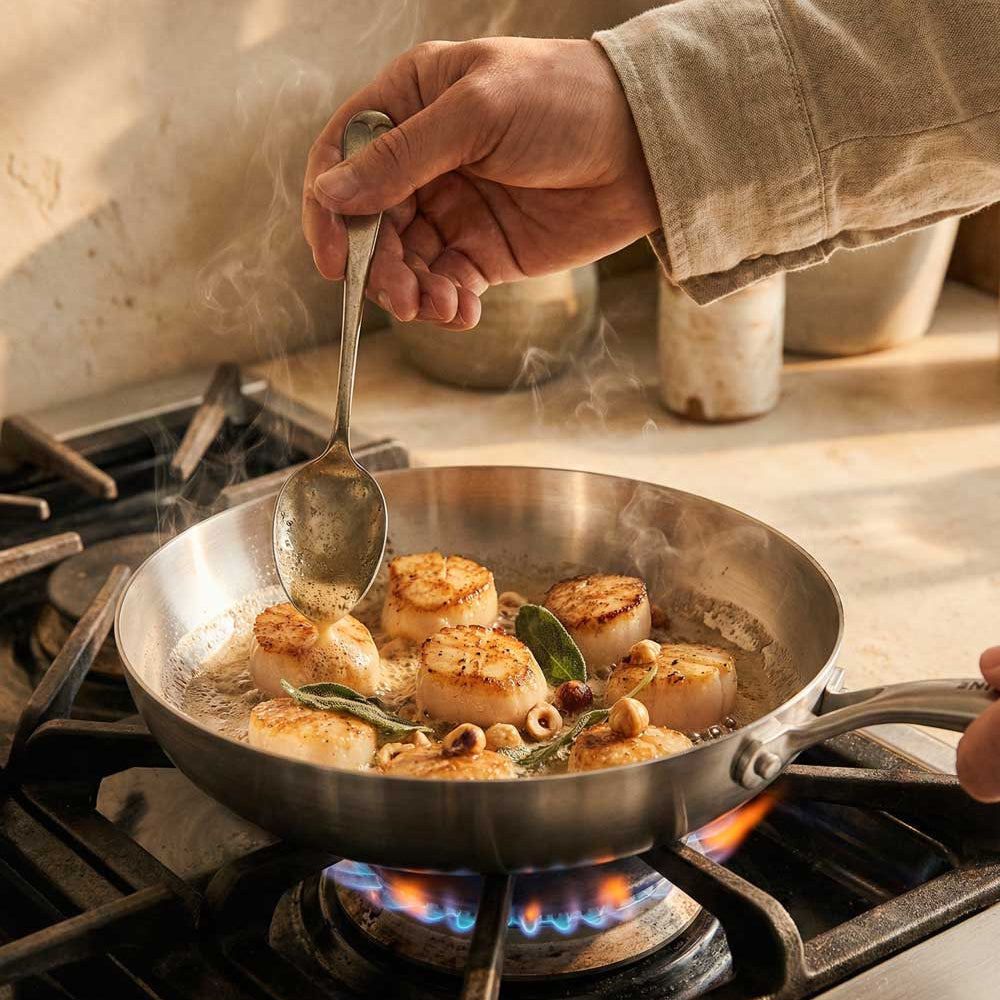
Stainless steel allows you to reach high temperatures to sear meats and caramelize the juices. This is the secret to gourmet sauces made by deglazing.
4. Withstands all temperatures
On the stovetop up to 300°C+, in the oven up to 260°C. You can start cooking on the stovetop and finish in the oven.
5. Ease of maintenance
It's a myth that stainless steel is difficult to clean. Deglazing with hot water removes everything. And it's dishwasher safe!
The advantages of a non-stick pan: For whom?
Let's be honest, it has advantages in certain contexts:
- ✅ Immediate ease: No technique required, works right away.
- ✅ Delicate foods: Excellent for eggs, pancakes and delicate fish.
The major drawbacks of the non-stick pan
- Ridiculous lifespan: 2 to 3 years maximum.
- Health hazards: Contains PFAS (perennial pollutants) which accumulate in the body.
- Limited performance: Unable to grip or deglaze.
- Environmental impact: Non-recyclable waste every 2 years.
👉 Complete guide to PFAS: Dangers of PFAS in non-stick pans: what you need to know
So, which one to choose? The decision guide
Our honest recommendation
For 95% of cooks, stainless steel pans are the best choice.
Yes, there's a short adjustment period. But then:
- 💚 You are protecting your health permanently
- 👨🍳 You cook better (really)
- 💰 You save money
- 🌍 You reduce your environmental impact
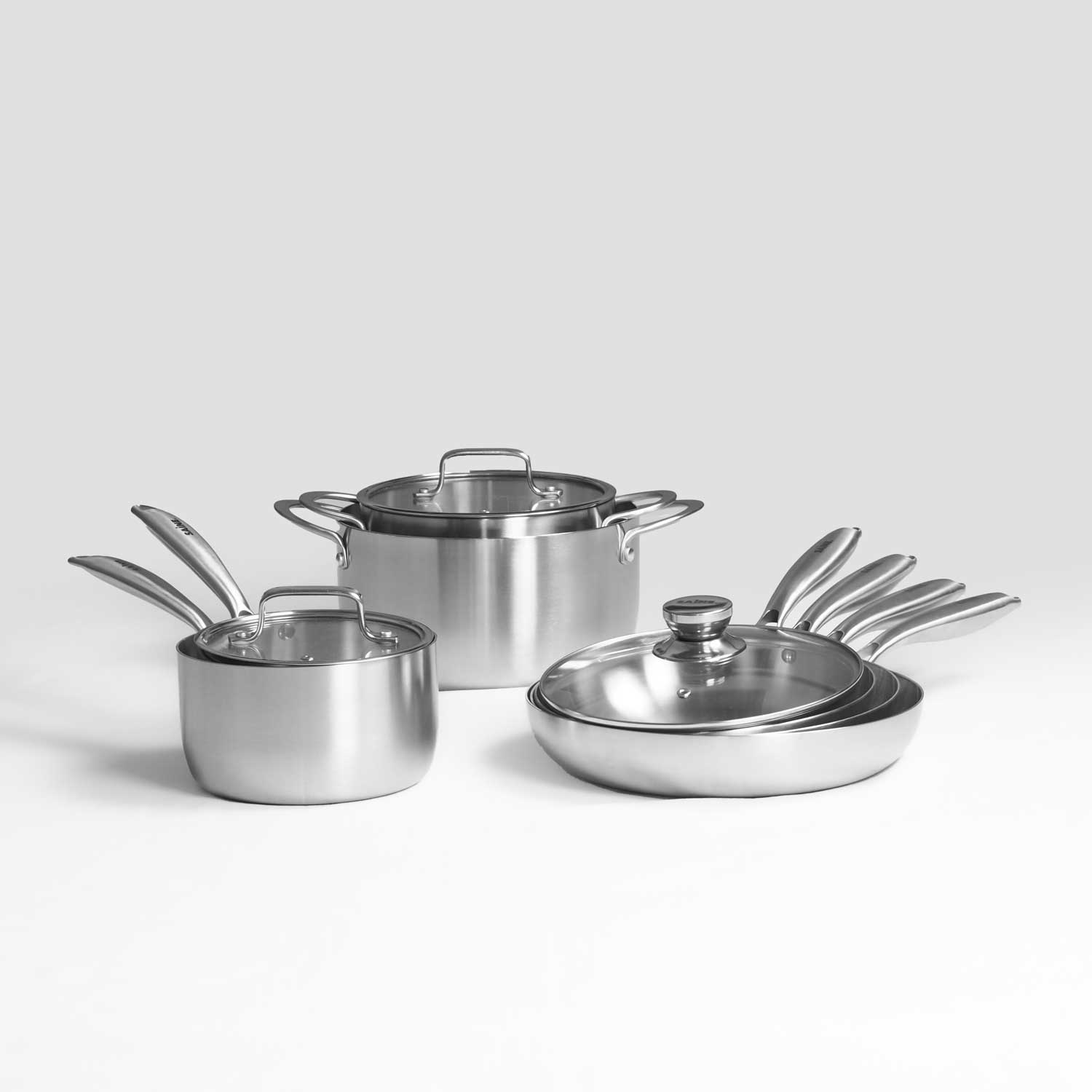
SAINE pans: Professional-grade stainless steel for everyone
At SAINE , we have made a radical choice: zero compromise on quality, health and sustainability.

Our commitment:
- 100% 18/10 stainless steel (grade 304)
- Zero toxic substances (PFAS/PTFE free)
- Tested in an independent laboratory (LFGB)
- High-performance 3-ply multi-layer base
- Lifetime warranty
How to master cooking with a stainless steel pan
The main concern with stainless steel? That food will stick. Here's the simple method.
The golden rule: Preheating
- Place your empty pan over medium heat.
- Let it heat for 2-3 minutes.
- Test with the drop of water (it should roll).
- Add the fat and cook!
👉 Complete guide: How to use a stainless steel pan: The complete guide
Conclusion: Stainless steel or non-stick pan?
If you are looking for a durable, healthy and ecological purchase, stainless steel wins hands down.
It's a purchase you'll never regret, and that you might even pass on to your children.
A non-stick pan remains a temporary solution, not an investment.
🌿 Cook healthily, sustainably and with confidence.
FAQ: Your questions
Do stainless steel pans stick?
No, if you preheat it properly (water drop test). It just takes a little practice.
Is it dangerous to cook with a scratched pan?
For stainless steel: NO (no danger). For non-stick: YES (releases PFAS, discard immediately).
Can you cook eggs in stainless steel?
Yes! With proper preheating, the eggs will detach naturally.
Induction compatibility?
Yes, all SAINE pans work on induction.
Share:
18/10, 18/8, 18/0 stainless steel: what's the difference? The guide to making the right choice.
Stainless steel or stainless steel frying pan: What's the difference and how to choose?