


⏱️ Pas le temps de tout lire ?
Le verdict en 1 phrase : exigez de l'inox 18/10 (AISI 304) pour la face intérieure (santé, résistance aux acides) et de l'inox 18/0 (AISI 430) en face extérieure si vous êtes sur induction. C'est la combinaison utilisée par toute la gamme SAINE.
→ Voir la poêle SAINE 28 cm (18/10 + 18/0) ou voir le sommaire
Retournez une poêle en inox et vous verrez probablement une inscription frappée dans le métal : 18/10, 18/8 ou 18/0. Trois petits chiffres que 9 acheteurs sur 10 ne savent pas lire, alors qu'ils résument presque tout ce qu'il faut savoir sur la qualité, la durabilité et la compatibilité d'une poêle.
Ces chiffres sont une norme métallurgique internationale qui indique la composition précise de l'acier inoxydable. Ils changent la résistance à la corrosion, la tenue aux acides des tomates et du vinaigre, la compatibilité induction, et même le risque allergique pour les peaux sensibles au nickel. Ignorer cette nomenclature, c'est acheter une poêle à l'aveugle.
Dans ce guide, vous allez comprendre ce que signifient vraiment 18/10, 18/8 et 18/0, comment ils se traduisent dans les normes AISI 304, 316 et 430, et surtout comment choisir la bonne nuance d'inox pour votre poêle selon votre plaque, votre budget et votre usage. C'est un point que notre guide complet pour choisir sa poêle inox mentionne comme critère non négociable. On le détaille ici en profondeur.

📑 Sommaire
- Que signifient ces chiffres au juste ?
- Inox 18/10 : le standard haut de gamme
- Inox 18/8 : un compromis qui a fait ses preuves
- Inox 18/0 : incontournable pour l'induction
- Tableau comparatif 18/10 vs 18/8 vs 18/0
- Quel inox choisir : les 4 critères
- Ce que SAINE utilise, et pourquoi
- Les nuances moins courantes (18/12, 316, chirurgical)
- FAQ : vos questions sur les types d'inox
- Verdict : les grades qui comptent vraiment
Découvrez la gamme SAINE en 1 clic

Poêle inox - 28 cm

Trio de poêles inox 22, 24 et 28 cm

Le duo de casseroles 16 et 18 cm

Batterie complète - 8 pièces + couvercles
🚚 Livraison offerte dès 150 € · ♾️ Garantie à vie · ⭐ +2 500 avis vérifiés
🔬 Que signifient ces chiffres au juste ?
Ces deux chiffres séparés par un slash ne sont ni un code de fabricant ni un modèle. Ce sont les deux éléments d'alliage principaux qui transforment un acier au carbone en acier inoxydable adapté à la cuisine.
Le premier chiffre = pourcentage de chrome. Le second = pourcentage de nickel. Le reste (≈70-72 %) est du fer, complété par de petites quantités de carbone, manganèse, silicium ou molybdène selon les nuances.
Le chrome : le bouclier anti-corrosion
L'essentiel : au contact de l'oxygène, le chrome forme une couche invisible d'oxyde (quelques nanomètres), auto-régénérante. C'est elle qui empêche la rouille et protège des acides. Minimum légal pour parler d'inox : 10,5 % de chrome. Les inox de cuisine en contiennent 18 % (d'où le « 18 » de chaque nomenclature).
Le nickel : finition, ductilité, magnétisme
L'essentiel : le nickel stabilise la structure cristalline en phase austénitique, améliore la résistance aux acides (tomate, vinaigre, citron) et rend l'acier non magnétique. Une poêle 100 % 18/10 n'accroche pas à un aimant, donc n'est pas compatible induction sans construction multicouche.
💡 Le point clé : 18/10 = 18 % chrome + 10 % nickel. 18/8 = 18 % chrome + 8 % nickel. 18/0 = 18 % chrome + 0 % nickel. Plus de nickel = meilleure résistance aux acides + plus de brillant, mais plus de magnétisme.
La nomenclature internationale (AISI 304, 316, 430)
18/10 et 18/8 sont la notation européenne. Les fiches techniques utilisent la norme AISI. Voici les correspondances utiles :
- 🏆 AISI 304 : correspond à 18/10 (et 18/8). Grade austénitique standard, excellente résistance, non magnétique.
- 💎 AISI 316 : encore plus résistant grâce au molybdène. L'inox dit « chirurgical » ou marin, utilisé dans certaines poêles premium.
- 🧲 AISI 430 : correspond à 18/0. Grade ferritique, magnétique, moins résistant aux acides. Utilisé pour les semelles induction.
Une bonne poêle inox moderne combine souvent plusieurs nuances dans un même produit : 18/10 pour la face intérieure, 18/0 pour la semelle extérieure, et un cœur d'aluminium ou de cuivre entre les deux. C'est la fameuse construction tri-ply ou fond capsulé.
🥇 Inox 18/10 : le standard haut de gamme
Quand on parle de poêle inox de qualité, on parle presque toujours de 18/10. C'est la nuance qui équipe la face intérieure des poêles premium depuis des décennies, de Cristel à All-Clad en passant par Demeyere, Mauviel et SAINE.
✅ Les avantages concrets du 18/10 :
- ✨ Brillance durable : aspect miroir qui ne ternit pas avec les années
- 🍋 Résistance aux acides : tomates, vinaigrettes, citron, vin blanc sans dommage
- 🛡️ Résistance à la corrosion : ne rouille pas, ne se pique pas, ne relargue pas
- ♾️ Durée de vie quasi illimitée : peut passer de génération en génération. C'est tout l'intérêt de miser sur l'inox plutôt que l'antiadhésif
Petite anecdote personnelle : quand j'ai découvert la métallurgie des inox en lançant SAINE, j'ai passé trois semaines à éplucher les fiches techniques des aciéries européennes. Ce qui m'a frappé : à grade équivalent (AISI 304), deux fabricants peuvent afficher l'un 18/10 et l'autre 18/8 avec exactement la même matière. La nomenclature est un repère commercial autant qu'une vérité chimique. Ce qui compte vraiment, c'est la conformité à la norme AISI 304 ou supérieure.
Inconvénients du 18/10 ?
Coût : le nickel est cher et volatil. Un 18/10 est sensiblement plus coûteux qu'un 18/0. Magnétisme : non magnétique seul, donc construction multicouche obligatoire pour l'induction. Allergie au nickel : dans un alliage austénitique, le nickel est chimiquement lié, le relargage reste extrêmement faible pour un usage normal. Pas de risque identifié pour la grande majorité des utilisateurs.
🥈 Inox 18/8 : un compromis qui a fait ses preuves
L'inox 18/8 est probablement le plus répandu dans le monde, tous usages confondus (couverts, ustensiles, électroménager, lave-linge, bijouterie fantaisie). Dans la poêle, il est aussi très présent en milieu de gamme et professionnel.
Techniquement, 18/8 et 18/10 appartiennent tous les deux à la famille AISI 304. La norme tolère une teneur en nickel entre 8 et 10,5 %. Un fabricant qui grave 18/8 respecte la norme, un fabricant qui grave 18/10 aussi. La différence pratique en cuisine est souvent plus marketing que chimique.
Cela dit, le 18/10 reste un cran au-dessus sur deux points :
- 🥇 Résistance aux acides prolongés : un mijotage de 2 h, une réduction de vinaigre. La différence devient perceptible sur la durée de vie de la couche passive.
- ✨ Finition miroir : le 18/10 garde plus longtemps son brillant. Critère non négligeable sur 20-30 ans.
🔍 Bon à savoir :
Le 18/8 est la norme quasi universelle pour les couverts de table (couteaux, fourchettes, cuillères). C'est exactement la même famille AISI 304 que l'intérieur d'une poêle haut de gamme.
🧲 Inox 18/0 : incontournable pour l'induction
L'inox 18/0 appartient à une famille très différente : les aciers ferritiques (AISI 430). L'absence totale de nickel change complètement son comportement.
- 🧲 Magnétique grâce au fer ferritique → compatible induction sans artifice
- 💰 Moins cher (pas de nickel à payer)
- 💊 Sans nickel → adapté aux personnes allergiques confirmées
- 🛡️ Résiste moins aux acides que le 304 (son principal défaut)
Dans les poêles modernes, le 18/0 est presque toujours utilisé en semelle extérieure, jamais en surface de contact alimentaire. Il est enchâssé dans une construction multicouche, parfois encapsulé par une couronne d'inox 304. Une poêle « compatible induction » bien conçue combine toujours les deux nuances : 18/10 à l'intérieur (santé, acides), 18/0 à l'extérieur (induction). Pour aller plus loin : guide complet poêle inox et induction.
📊 Tableau comparatif : 18/10 vs 18/8 vs 18/0
Récapitulatif visuel pour mémoriser les différences en une seule lecture.
| Critère | Inox 18/10 (AISI 304) | Inox 18/8 (AISI 304) | Inox 18/0 (AISI 430) |
|---|---|---|---|
| Composition | 18 % Cr + 10 % Ni | 18 % Cr + 8 % Ni | 18 % Cr + 0 % Ni |
| Famille | Austénitique | Austénitique | Ferritique |
| Magnétique | ❌ Non | ❌ Non | ✅ Oui |
| Compatible induction | ❌ Seul | ❌ Seul | ✅ Oui |
| Résistance acides | ✅ Excellente | ✅ Très bonne | ⚠️ Moyenne |
| Contact alimentaire | ✅ Idéal | ✅ Idéal | ⚠️ Déconseillé |
| Risque allergie nickel | ⚠️ Très faible | ⚠️ Très faible | ✅ Nul |
| Coût matière | Élevé | Élevé | Modéré |
| Usage typique | Intérieur poêle haut de gamme | Couverts, intérieur poêle milieu de gamme | Semelle induction, coque extérieure |
La lecture est claire : aucune nuance ne gagne sur tous les critères. Le choix intelligent n'est pas de prendre « le meilleur inox » dans l'absolu, mais une poêle qui combine les bonnes nuances aux bons endroits.

🏆 La combinaison gagnante
Poêle SAINE 28 cm - 18/10 + 18/0 - 79 €
📖 Quel inox choisir : les 4 critères qui tranchent
En pratique, vous ne choisissez pas entre 18/10, 18/8 et 18/0 comme entre trois téléviseurs. Vous choisissez une poêle, qui combine une ou plusieurs nuances. Voici les 4 critères qui orientent le bon choix.
1. 🍳 Le type de cuisson que vous pratiquez
Plats acides (tomates, citron, vinaigre, vin) : exigez 18/10 (AISI 304) à l'intérieur. Tenue de la couche passive bien meilleure sur le long terme.
Saisie viande, légumes sautés, œufs : 18/8 ou 18/10 fait parfaitement le job. Voir le guide complet de la cuisson à l'inox.
2. ⚡ Votre source de chaleur
Plaque induction : poêle impérativement magnétique = semelle 18/0 (AISI 430) ou disque ferromagnétique. Une poêle 100 % 18/10 ne chauffera tout simplement pas. Voir comment vérifier la compatibilité induction.
Gaz, vitrocéramique, électrique, halogène : toutes les nuances fonctionnent. Plus de liberté.
3. 💊 Une allergie au nickel dans le foyer
Cas minoritaire mais sérieux. Environ 15-20 % de la population présente une sensibilité cutanée au nickel, mais l'allergie alimentaire reste rare (1-2 % des cas). Dans un alliage 18/10, le nickel est fixé dans la matrice austénitique : relargage extrêmement faible, jugé sans risque par les autorités. Pour une allergie confirmée, la fonte brute ou des ustensiles 18/0 à contact direct sont des alternatives.
4. 💰 Votre budget et votre horizon d'utilisation
Une poêle 18/10 haut de gamme coûte 60-120 € en moyenne. Plus qu'une antiadhésive d'entrée, mais l'équation se renverse dès la 3e ou 4e année : antiadhésives à changer tous les 2-3 ans, inox à vie.
Sous 30 €, méfiance : on trouve souvent des fonds trop fins (1 mm ou moins), qui se déforment et chauffent mal. Voir notre article sur les pièges des poêles inox bon marché.
✅ La règle simple pour bien choisir :
- 🍳 Intérieur 18/10 (AISI 304) : exigence minimale pour la surface de contact alimentaire
- 🧲 Semelle 18/0 (AISI 430) ou disque ferromagnétique : indispensable sur induction
- 🏗️ Construction multicouche (tri-ply ou fond capsulé épais) : garantit diffusion uniforme et anti-déformation
🏭 Ce que SAINE utilise, et pourquoi
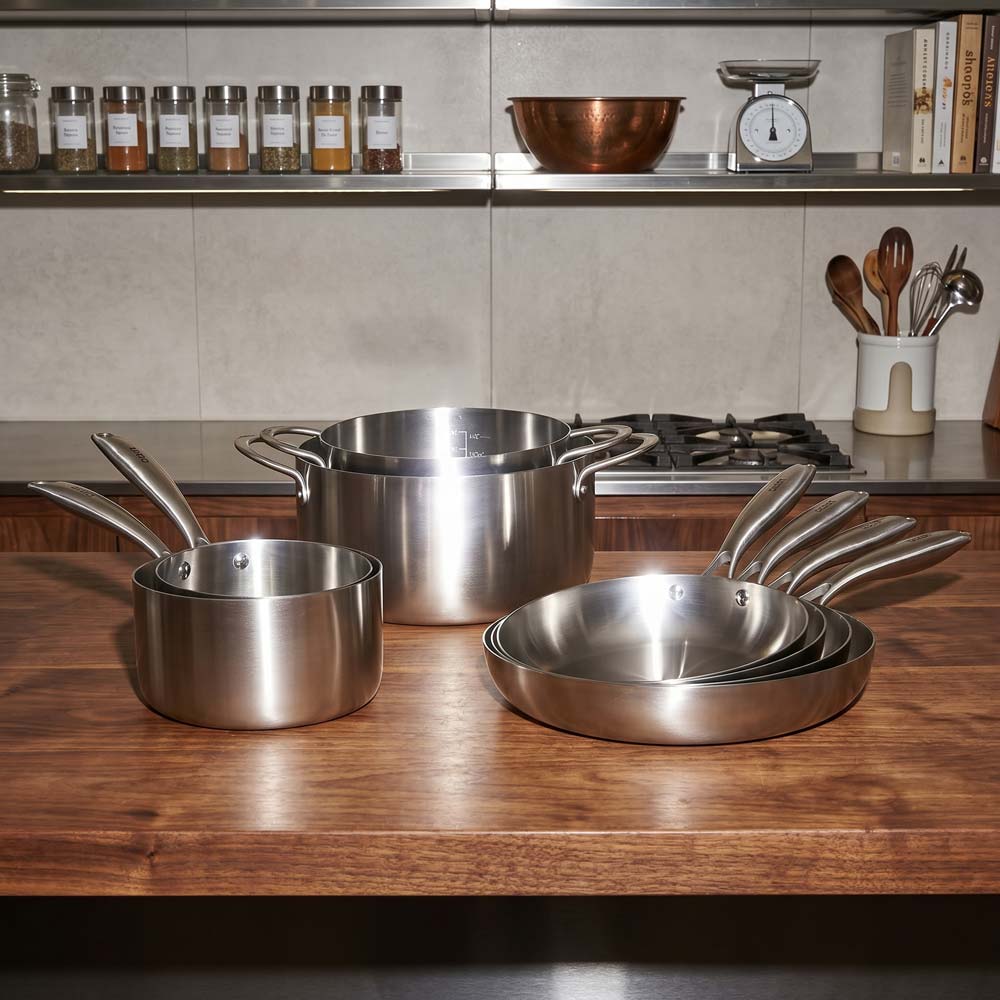
Toutes nos poêles et casseroles combinent inox 18/10 en face intérieure (AISI 304) et inox 18/0 en semelle extérieure (AISI 430 compatible induction), avec un cœur d'aluminium pour la conduction thermique. C'est la construction tri-ply intégrale, standard des poêles professionnelles.
Concrètement, vous obtenez :
- ✨ Surface 18/10 qui ne relargue pas, résiste aux sauces acides, garde son brillant miroir
- 🧲 Fond 18/0 compatible induction, gaz, vitrocéramique, halogène, four
- 🔥 Diffusion homogène grâce au cœur alu intégral (pas seulement un disque au centre)
- ♾️ Garantie à vie sur tous nos produits
La poêle inox 28 cm best-seller est la taille recommandée pour usage quotidien couple ou petite famille. Elle combine exactement cette construction 18/10 + 18/0 + cœur alu.
Pour comparer avec les options du marché, consultez notre comparatif des meilleures poêles inox 2026. Si vous hésitez encore avec un autre matériau, voir inox, fonte, céramique ou antiadhésif.
Pour équiper toute votre cuisine
💡 La solution la plus rentable pour passer à l'inox 18/10 + 18/0 en une seule fois.

Batterie compacte - 5 pièces + couvercles

Batterie complète - 8 pièces + couvercles

Batterie essentielle - 6 pièces + couvercles

Trio de poêles 22, 24 et 28 cm
🔬 Les nuances moins courantes (18/12, 316, chirurgical)
Vous croiserez parfois des mentions plus pointues dans les fiches techniques. Décodage rapide.
- 🔬 Inox 18/12 : 18 % chrome, 12 % nickel. Proche de la norme AISI 304L (low carbon). Utilisé dans l'agroalimentaire industriel, rare en cuisine domestique.
- ⚗️ Inox 18/10 + molybdène : correspond à l'AISI 316, parfois appelé « inox chirurgical ». Résistance aux chlorures (eau de mer, saumure) supérieure au 304. Présent dans certaines gammes premium type Demeyere Atlantis ou Proline.
- 🧪 Inox 17/7 ou 17/0 : variantes plus économiques, moins résistantes à la corrosion que le 18/0. À éviter pour une surface de cuisson.
Pour une poêle de cuisine familiale, le 18/10 AISI 304 reste le meilleur rapport qualité/prix/performance. Le 316 apporte un gain marginal qui ne justifie pas un surcoût de 40-60 %.
❓ FAQ : vos questions sur les types d'inox
L'inox 18/10 est-il meilleur que l'inox 18/0 ?
Ça dépend de l'usage. Pour la surface de contact alimentaire, le 18/10 est supérieur (résistance aux acides, brillant). Pour la semelle qui chauffe sur induction, le 18/0 est indispensable (seul magnétique). Une bonne poêle combine les deux. Voir aussi poêle inox et acier inoxydable.
Comment savoir si ma poêle est en 18/10 ou 18/0 ?
Trois méthodes : marquage gravé sur le fond, fiche produit du fabricant, test de l'aimant. S'il colle à l'intérieur, ce n'est pas du 18/10. S'il colle uniquement à l'extérieur, c'est une construction mixte 18/10 + 18/0 (signe d'une poêle bien conçue pour l'induction).
Peut-on utiliser une poêle 18/0 au contact direct des aliments ?
Oui, c'est légal et conforme aux normes alimentaires européennes. Mais le 18/0 résiste moins bien aux acides forts et aux lavages répétés. Sur 10+ ans, la couche passive peut se dégrader plus vite. Pour un usage quotidien avec des plats acides, préférez du 18/10 en intérieur.
L'inox 18/10 est-il dangereux pour la santé ?
Non, pour la population générale. L'EFSA et l'ANSES considèrent l'AISI 304 comme sûr pour le contact alimentaire, y compris pour les aliments acides. Le relargage de chrome, nickel et fer reste très inférieur aux limites sanitaires. Voir le pilier quelle est la poêle la plus saine pour la santé.
Pourquoi les couverts sont-ils souvent en 18/8 et pas en 18/10 ?
Raisons économiques. Les couverts ne subissent pas de mijotage acide prolongé, la différence est imperceptible. Les fabricants économisent 2 % de nickel sur des productions de masse. Les deux nuances respectent la norme AISI 304.
Inox 18/10 et inox 304, c'est pareil ?
Oui. 18/10 est la notation européenne courante, 304 la référence AISI. Les deux désignent un inox austénitique à 18 % de chrome et environ 10 % de nickel.
Peut-on avoir une poêle inox compatible induction sans 18/0 ?
Oui, certains fabricants utilisent un disque ferromagnétique en acier au carbone (non inox) enchâssé dans le fond, protégé par des couches d'inox 304. Ça marche, mais la construction est plus complexe et parfois moins durable qu'une vraie solution 18/10 + 18/0.
L'inox 18/10 raye-t-il plus facilement que le 18/0 ?
Non, dureté de surface comparable. La rayure dépend plus des ustensiles tranchants que de la nuance. Pour préserver la poêle, privilégiez bois ou silicone et voir notre guide d'entretien complet.
✅ Verdict : les grades qui comptent vraiment
Trois choses à retenir avant de passer commande :
1. La surface intérieure doit être garantie 18/10 ou AISI 304. Critère non négociable pour la santé, la résistance aux acides et la tenue dans le temps. Sans cette mention sur la fiche produit, passez votre chemin.
2. Sur induction, vérifiez la présence d'une semelle 18/0 ou d'un disque ferromagnétique. L'aimant qui colle au fond est le test le plus simple en magasin comme à la réception.
3. Ne vous laissez pas impressionner par les nuances exotiques. Pour 95 % des usages domestiques, une tri-ply 18/10 + alu + 18/0, fond ≥ 2,5 mm, fait exactement le travail, pour la vie.
C'est cette équation que j'ai voulu rendre accessible avec SAINE : des poêles inox bien construites, sans revêtement toxique, avec une garantie à vie assumée. Le bon grade d'inox au bon endroit, ni plus, ni moins.
🏆 Le bon grade au bon endroit
Poêle SAINE 28 cm - 79 €
📚 Pour aller plus loin
- 👉 Comment choisir sa poêle en inox : guide complet
- 👉 Comparatif des meilleures poêles inox 2026
- 👉 Poêle inox et induction : guide complet
- 👉 Fond capsule vs tri-ply intégral
📚 Sources et références :
- EFSA, avis scientifique sur la sécurité des matériaux en acier inoxydable au contact alimentaire
- ANSES, fiche sur les matériaux au contact des aliments (acier inoxydable)
- Normes AISI / ASTM A240 (spécifications des aciers inoxydables austénitiques et ferritiques)
- Norme européenne EN 10088-1 (aciers inoxydables, liste des nuances)
- Publications du Centre Information Chrome Nickel (CINI) sur les alliages 304 et 430



Partager:
Poêle Inox et Induction : Le Guide Complet pour Bien Choisir (2026)
Poêle Inox ou Acier Inoxydable : Quelle différence et comment choisir ?