


Non-stick pans have revolutionized modern cooking. They are practical, easy to clean, and allow for cooking without excessive fat. For decades, they have been a staple in millions of kitchens worldwide.
But did you know that they can contain PFAS, chemicals that are extremely dangerous for your health and the environment?
Nicknamed "eternal pollutants," these chemical compounds almost never break down in nature. They accumulate in our bodies, in the water we drink, in the soil where our food grows... and their effects on health are alarming.

👉 In this comprehensive article, discover exactly what PFAS are, how they are released from your pans, what dangers they really represent, and above all: how to avoid them permanently to adopt a truly healthy cooking style.
What are PFAS? Understanding these "perennial pollutants"
PFAS (per- and polyfluoroalkyl substances) constitute a family of more than 4,700 different synthetic chemical compounds , manufactured by humans since the 1950s.
Why are these substances used everywhere?
PFAS possess exceptional chemical properties that make them extremely useful to industry:
- 🧈 Non-stick properties : nothing sticks to their surface (hence the Teflon)
- 💧 Water and oil resistance (water and oil repellent)
- 🔥 Thermal stability : withstands extreme temperatures
- ⚗️ Chemical resistance : they react with almost nothing
Where can PFAS be found?
It is precisely this exceptional stability that poses a problem. PFAS are present in thousands of everyday products:
- 🍳 Non-stick pan coatings (PTFE, Teflon, and other brands)
- 📦 Food packaging (pizza boxes, microwave bags)
- 👕 Waterproof textiles (rainwear, rugs)
- 💄 Some cosmetic products
- 🧯 Fire-fighting foams
- 📱 Electronics and cables
The major problem: perpetual accumulation
Consequences :
- 🌍 PFAS persist in the environment for hundreds, even thousands of years
- 💧 They cause lasting contamination of groundwater and drinking water
- 🌱 They accumulate in agricultural soils
- 👤 They accumulate in the human body and remain there for years
How do PFAS get released from non-stick pans in your kitchen?
You might be thinking: "My pan isn't releasing anything, it's working perfectly." Unfortunately, the reality is more worrying.
PFAS incorporated into non-stick coatings like PTFE (Teflon) , although designed to be stable, are not completely so under domestic use conditions .
1. High-temperature release
🔥 The critical threshold: 260°C
Above 260°C, the PTFE coating begins to degrade chemically. This degradation releases:
- Visible or invisible toxic fumes
- Ultrafine PFAS particles disperse into the air of your kitchen
- Potentially dangerous fluorinated gases
💡 Concrete example: A non-stick pan left empty on a medium-high heat easily reaches 300 to 350°C in just 3-5 minutes . This is a situation that happens to everyone.
2. Release by scratches and mechanical wear
🔪 Every strike with a metal spatula can cause problems
Even if you use wooden or silicone utensils, the non-stick coating will gradually wear off with use.
- Repeated rubbing during cleaning
- Thermal shock (hot pan plunged into cold water)
- Micro-scratches invisible to the naked eye
- The natural aging of the material
The result: Invisible microparticles of PFAS detach and mix directly with your food. You ingest them without even realizing it.
3. Cumulative release during repeated cooking
🍲 The effect of time: a risk that accumulates
Even without overheating or visible scratches, simply repeated use of your non-stick pan leads to progressive degradation and a cumulative release of PFAS.
👉 To learn more about the mechanisms of contamination: Non-stick pans: why are they a danger to your health?
The dangers of PFAS to human health: What science says
PFAS are not simply abstract environmental pollutants. They accumulate in your body and can remain there for years, even decades .
How PFAS enter and remain in your body
Routes of exposure: Ingestion (food, water), Inhalation (fumes), Skin contact.
Bioaccumulation: Once in your body, PFAS are mainly stored in the blood, liver, and kidneys.
According to the US CDC, 97% of the population has measurable traces of PFAS in their blood.
Scientifically documented health risks
Hundreds of international studies have demonstrated a link between chronic exposure to PFAS and serious health problems.
The scientific consensus and the health authorities
What the experts (ECHA, EPA, ANSES, WHO) say:
Even at very low doses, the effects of PFAS accumulate over time . There is no clearly established "safe threshold." Therefore, the precautionary principle dictates limiting your exposure as much as possible.
The dangers of PFAS to the environment: Irreversible pollution
PFAS do not just pose a danger to your individual health. They constitute one of the most serious environmental crises of the 21st century .
Why PFAS Never Go Away
PFAS are called "forever pollutants" for a specific scientific reason: their molecular structure is exceptionally stable . Bacteria, light, or water cannot break them down.
Sources of environmental contamination
- 💧 Contamination of drinking water: Groundwater polluted by industrial discharges.
- 🐟 Bioaccumulation: PFAS move up the food chain to us.
- 🌱 Soil pollution: Agricultural land retains PFAS for decades.
👉 To understand the overall impact and sustainable solutions: Why a stainless steel pan is an eco-friendly and responsible choice
How to avoid PFAS in your kitchen: Healthy alternatives
Faced with this alarming situation, the good news is simple: there are proven, healthy and sustainable alternatives to non-stick pans .
✅ Solution #1: Stainless steel (inox) pans
Stainless steel is the best alternative:
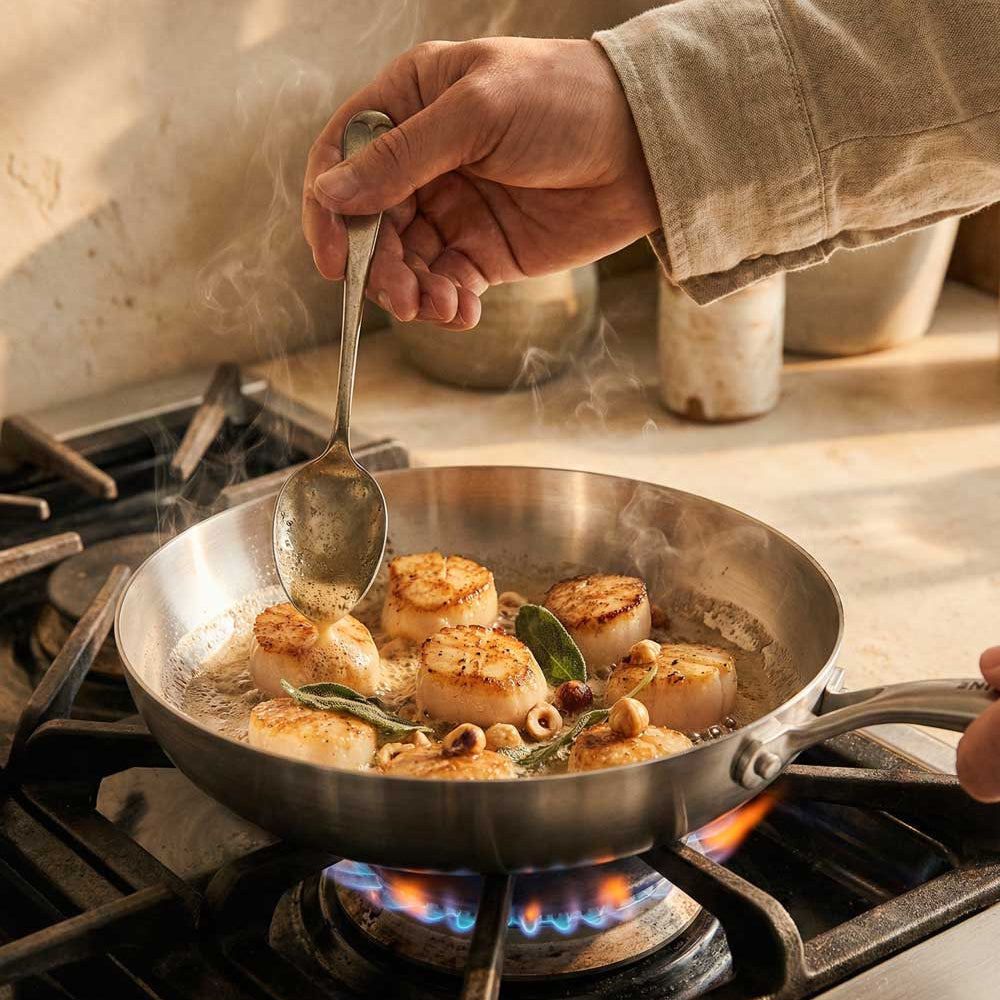
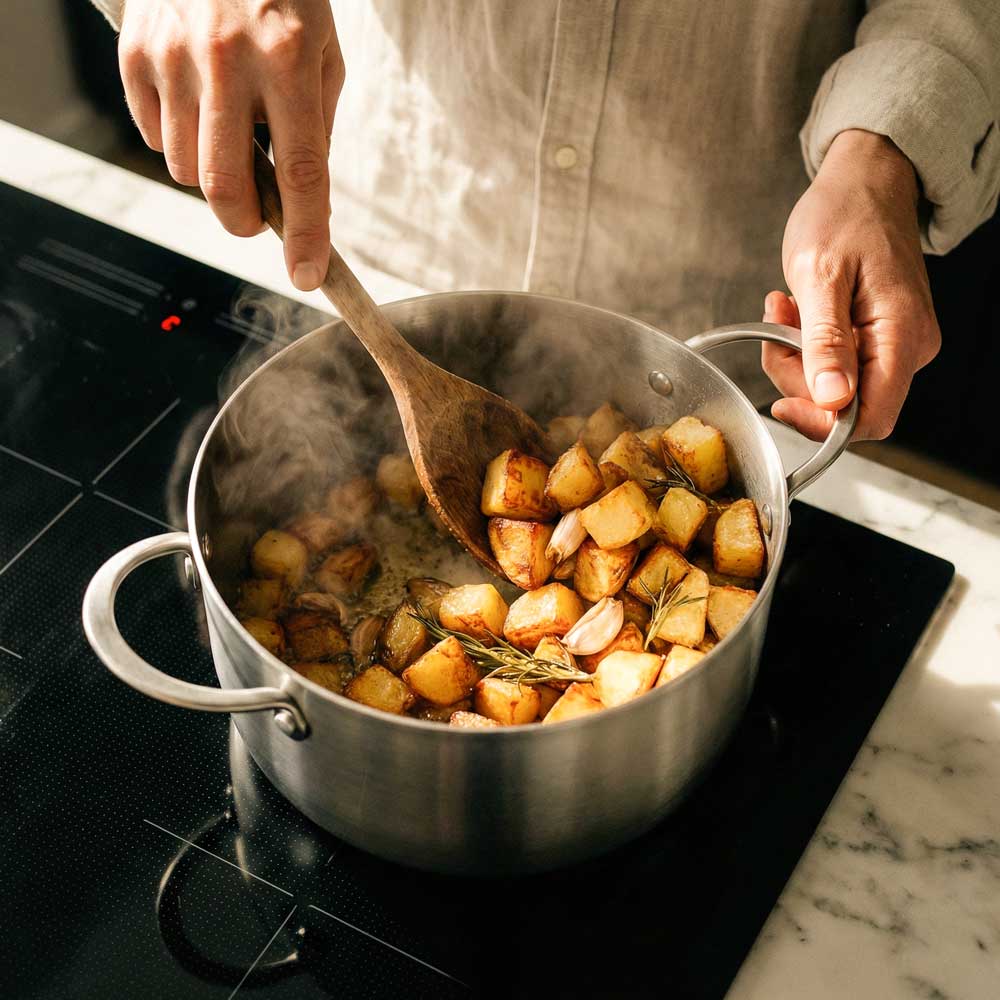
- 🚫 0% chemical coating : no PFAS, no PTFE
- 🔥 Excellent heat resistance
- ⏱️ Exceptional durability (30 years and more)
- 🍳 Precise and even cooking
- 🧪 Completely inert

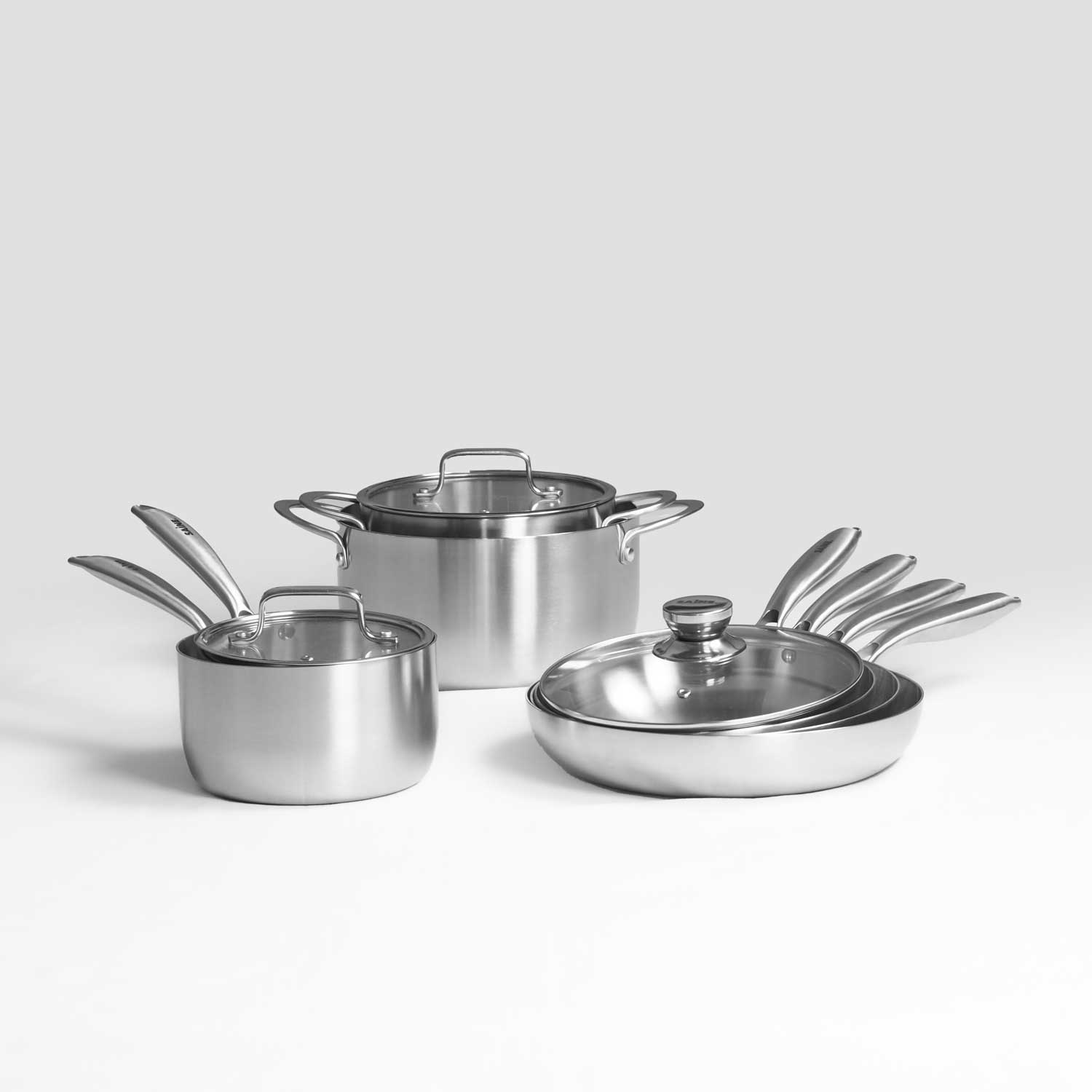
SAINE pans: Certified 18/10 stainless steel without compromise
SAINE pans are made of food-grade 304 (18/10) stainless steel , the highest grade used in hospitals and professional kitchens.
They are tested in an independent laboratory (LFGB standard), guaranteed for life and feature a 3-ply multilayer base for optimal performance.
✅ Solution #2: Natural cast iron pans
Highly durable and chemically uncoated, they are perfect for simmering. However, be mindful of their weight and maintenance (seasoning is necessary).
⚠️ Beware of false alternatives
Caution:
- Ceramics: Check for "PFAS/PTFE free" certification.
- Non-stick "PFOA-free": This is often greenwashing. PFOA is replaced by other PFAS. If it doesn't stick chemically, be wary.
Why choose SAINE: Our commitment to your health
At SAINE , we made the radical choice of stainless steel for one simple reason: it is the only material that guarantees a 100% healthy, efficient and durable kitchen .
Our promise:
- 💚 Protect your health : zero toxic substances
- 🌍 Respect the planet : recyclable material, extreme durability
- 👨🍳 Elevate your cooking : chef-quality performance
- 💎 Lasts a lifetime : a one-time purchase
👉 To learn everything about stainless steel safety: The dangers of stainless steel pans: do they contain toxic substances? The scientific truth


Share:
Why is a stainless steel pan an ecological and responsible choice?
Choosing a stainless steel pan for a plastic-free kitchen: The complete guide for a successful transition