


Today, more and more households are looking to reduce their exposure to plastic in the kitchen. And for good reason: the dangers are real and documented.
Disposable packaging, utensils that melt in the heat, non-stick coatings that flake off and release invisible microparticles... Plastic is everywhere, even where you least expect it. Worse still: it hides in unsuspected places in your kitchen, including in your pots and pans.
Why not start with the essentials?
Choosing a stainless steel pan is a concrete and immediate first step towards a plastic-free, chemical-free kitchen, without compromising on quality or performance. It's an investment in your health and that of your family. 🌿

Why plastic in the kitchen is a real health problem
Plastic never remains completely inert, especially when exposed to heat. During cooking, it can release harmful chemicals that migrate directly into your food and end up in your body.
The hidden dangers of plastic in your kitchen
Endocrine disruptors
These chemical molecules mimic or block your natural hormones. Found in some plastics, they can affect fertility, development, metabolism, and even increase the risk of certain cancers. BPA (bisphenol A) is the best-known example, but there are hundreds of other similar compounds.
PFAS (per- and polyfluoroalkyl substances)
Dubbed "perpetual pollutants," these chemicals are used in the non-stick coatings of many pans. They persist in the environment and accumulate in the human body. Scientific studies link them to immune system disorders, thyroid problems, and an increased risk of certain cancers.
Phthalates
Used to make plastics more flexible, they are found in some kitchen utensils. Like endocrine disruptors, they interfere with the hormonal system.
Where is the plastic hiding in your kitchen?
Plastic is not limited to packaging. It is found in:
- 🍴 Plastic utensils (spatulas, spoons, colanders) that melt or degrade with heat
- 🍳 Non-stick coatings on pans (Teflon, PTFE, low-end ceramic) that flake off and release microparticles
- 🔥 Plastic handles and grips that warp, crack, and emit toxic odors over time
- 📦 Storage containers , even those labeled "BPA-free," often contain other problematic plasticizers.
- 🥤 Poor quality reusable bottles and flasks
The problem of microplastics
Recent studies show that we ingest the equivalent of a credit card's worth of plastic every week. Some of this comes from our kitchens, particularly from utensils and coatings that gradually degrade.
👉 To fully understand the risks: Why are non-stick pans toxic? The dangers of PFAS
The solution: A stainless steel pan, zero plastic, zero compromise
Faced with these dangers, the solution is simple and proven: stainless steel.
With a stainless steel pan, you instantly eliminate all these risks:
✅ Zero plastic (even the handles are 100% metal)
✅ Zero toxins (no chemical coating)
✅ Zero stress (completely inert material)
Why stainless steel is the safest alternative
Stainless steel is not a newcomer to our kitchens. It's a material that has been tried and tested for decades, used in:
- 🏥 Surgical instruments and medical equipment
- 👨🍳 Professional kitchens from around the world
- 🏭 The food industry for its absolute neutrality
- 🚀 Aerospace for its extreme resistance
If stainless steel is the material of choice in these areas where safety is paramount, why accept anything less in your kitchen?
SAINE pans: Medical-grade 18/10 stainless steel
SAINE pans are made of 304 (18/10) stainless steel , the highest grade for food use. It's the same alloy used in hospitals and Michelin-starred kitchens.
Composition and certifications
The 18/10 alloy means:
- 18% chromium → Creates a passive layer that protects against corrosion and prevents any metallic migration
- 10% nickel → Stabilizes the alloy, guarantees brightness and total chemical inertness
- ~70% iron → Solid and durable base
Our health insurance coverage:
- 🧴 Without any coating (no layer that flakes or degrades)
- 🚫 Free from PFAS, PFOA, PTFE (zero "eternal pollutants")
- 🪶 100% plastic-free (even the handles are stainless steel)
- 🔬 Tested in an independent laboratory (LFGB certified)
- ♻️ Lifetime warranty (a final purchase, not a consumable)
The science that proves the safety of stainless steel
This material does not release any toxic substances , even at high temperatures, and does not degrade over time. This is scientifically proven.
Our pans were analyzed by the Shenzhen ZTS Testing Service laboratory according to the LFGB standard (German legislation, the strictest in the world). The result: no detectable migration of nickel, chromium, lead, cadmium, or mercury . Zero. Nothing. Even after prolonged exposure to heat and food acids.
👉 All the scientific details: The dangers of stainless steel pans: do they contain toxic substances? The scientific truth
Discover our range now:
👉 HEALTHY stainless steel pans - Healthy and sustainable cooking
💡 Maximum performance: Zero compromise on cooking quality
Switching to a plastic-free kitchen does not mean sacrificing performance at all. On the contrary.
Stainless steel is considered by professional chefs to be the best cooking material , far superior to non-stick pans in terms of culinary results.
The culinary advantages of stainless steel
🔥 Optimal thermal conductivity
Thanks to the 3-ply multi-layer base (stainless steel + aluminum + stainless steel), heat is distributed evenly across the entire surface. No more hot spots that burn in the center while the edges remain lukewarm.
🍽 Even and controlled cooking
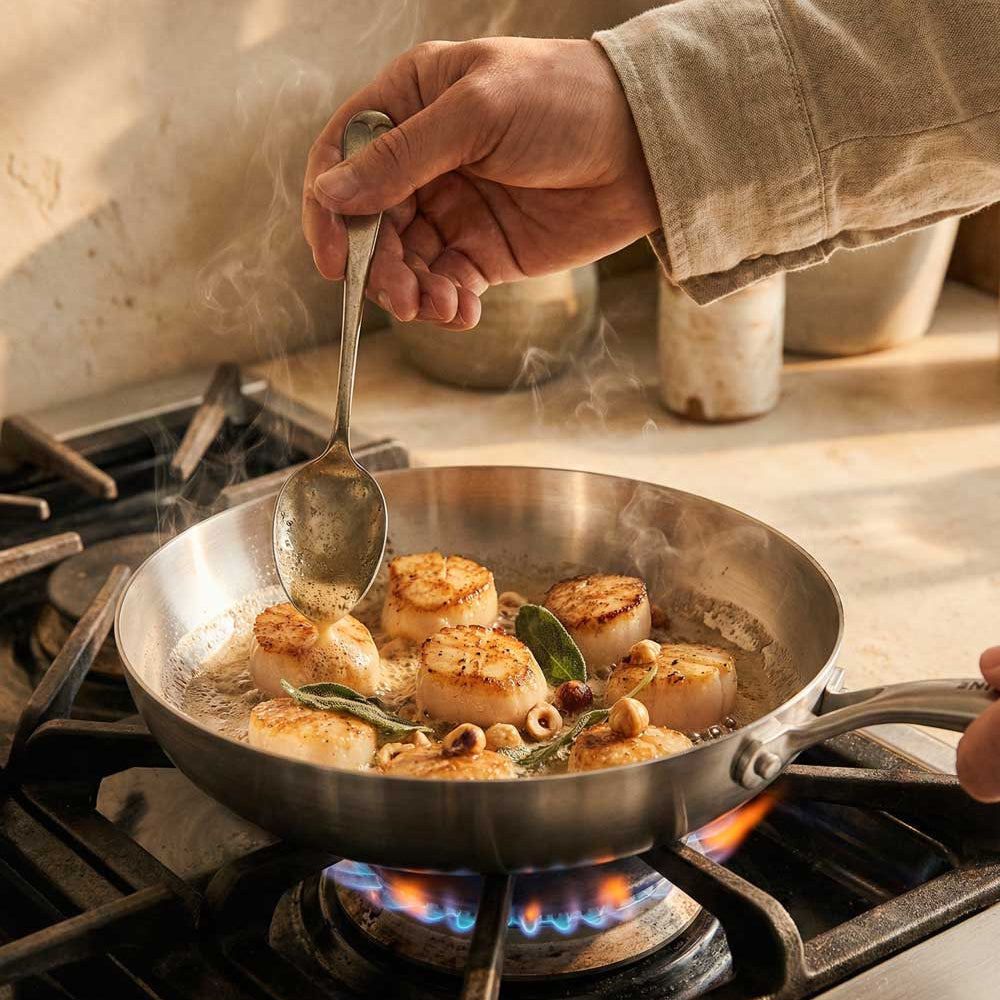
You precisely control the temperature. The Maillard reaction (that golden and flavorful crust) develops perfectly. Meats are seared to perfection, and vegetables caramelize without burning.
🎯 Total versatility
A HEALTHY stainless steel pan allows you to:
- Searing meats at high temperatures (impossible with non-stick coating)
- Cook without excessive fat (contrary to popular belief)
- Deglaze and create exceptional sauces (caramelized juices are a treasure trove of flavor)
- Can be transferred from stovetop to oven without any problem (up to 260°C)
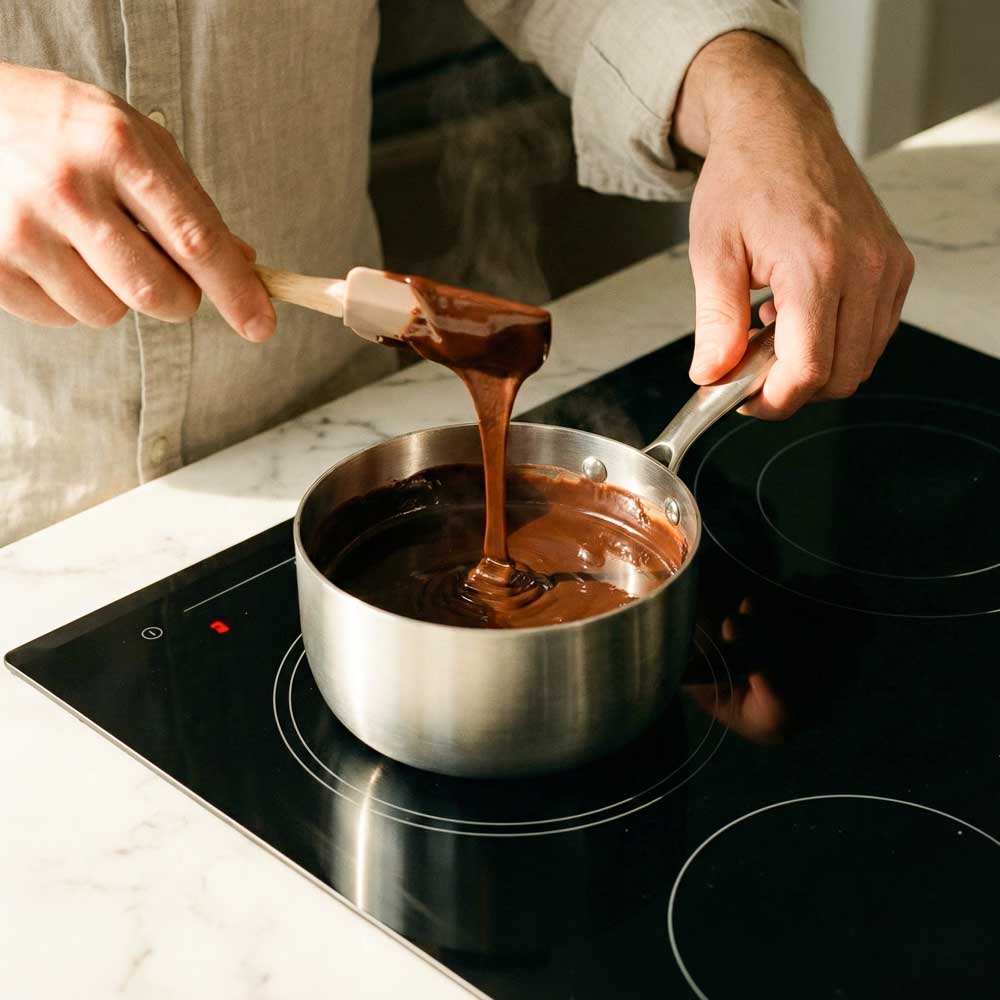
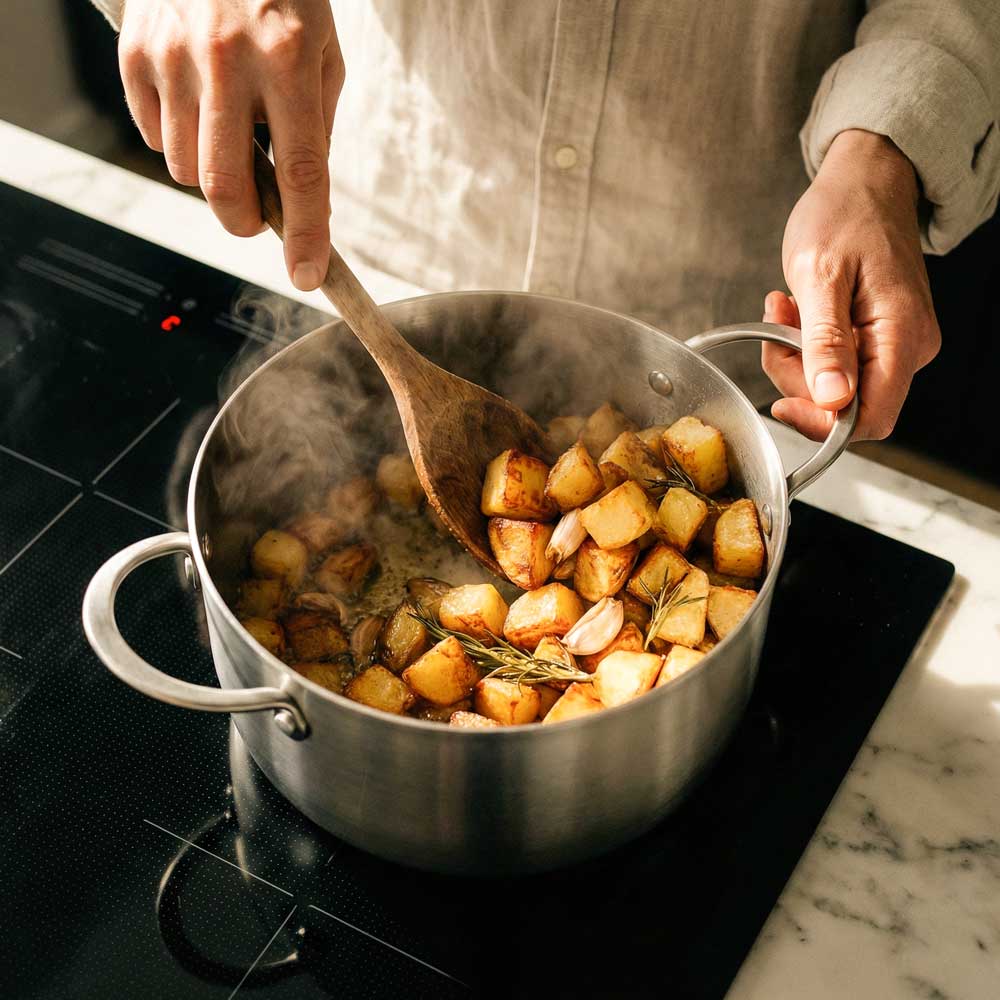
- Use on all heat sources (gas, electric, ceramic glass, induction)
🧪 Absolute taste neutrality
Unlike aluminum or cast iron, stainless steel does not react with acidic foods (tomatoes, wine, lemon). The taste of your dishes remains pure and authentic.
The technique to prevent it from sticking
The main fear with stainless steel? That food will stick. This fear is understandable, but unjustified if you master the correct technique.
The golden rule: preheating
- Place your empty SAINE pan on medium heat
- Let it heat up for 2-3 minutes
- Test it with a drop of water: if it forms a bead that "dances", it's perfect.
- Add your fat (oil, clarified butter)
- Place your food on top and leave it alone for 2-3 minutes.
- They will detach naturally once the crust has formed.
This is a physical phenomenon called the Leidenfrost effect . At the right temperature, a micro-layer of vapor forms between the food and the metal, creating a natural non-stick effect. No need for Teflon.
💡 Free complete guide:
👉 How to use a stainless steel pan: The complete guide to successful cooking every time
♻️ Sustainability: A cleaner kitchen for the planet
Choosing a stainless steel pan is also making a strong and consistent ecological choice.
The disastrous environmental impact of disposable pans
According to market research, a non-stick pan has an average lifespan of 2 to 3 years . After that:
- The coating flakes off and becomes dangerous
- The pan ends up in the trash (not recyclable in most cases)
- You buy a new pan
- The cycle begins again...
Consequences :
- 💰 Cumulative cost over 30 years: 10 to 15 stoves = €300-600
- 🗑️ Waste: 10-15 non-recyclable pans in landfills
- 🏭 Production: Energy and resources wasted to manufacture 15 stoves instead of one
- ☠️ Pollution: PFAS seeping into soils and groundwater
Stainless steel: An eco-friendly investment for generations
A quality 18/10 stainless steel pan is designed to last a lifetime , or even several generations.
The environmental advantages of stainless steel:
- ♻️ 100% infinitely recyclable without loss of quality (unlike plastic which degrades with each recycling)
- 🌍 Carbon footprint offset over decades of use
- 🛡️ No chemical pollution (no PFAS escaping into the environment)
- 🔧 Repairable (no coating to replace)
- 👶 Passable on to future generations
The calculation is simple:
🌱 By replacing 10-15 "disposable" pans with a single HEALTHY stainless steel pan, you avoid kilos of non-recyclable waste and significantly reduce your carbon footprint.
This is what we call responsible consumption : buying less, but better. Investing in quality rather than disposable products.
👉 Explore the topic further: Why a stainless steel pan is an eco-friendly and responsible choice
🎯 How to successfully transition to a plastic-free kitchen
Switching to a plastic-free kitchen may seem daunting, but it's simpler than it looks. Here's a step-by-step, realistic approach.
Step 1: Start with the essentials (your pots and pans)
This is where plastic and chemicals pose the greatest risk, as they are directly exposed to heat.
Replace first:
- Scratched or chipped non-stick pans
- Plastic cooking utensils (spatulas, spoons)
- Pots and pans with plastic handles that degrade
By what?
- ✅ 18/10 stainless steel pans (HEALTHY) for all types of cooking
- ✅ Utensils made of wood, stainless steel or high-temperature silicone
- ✅ Stainless steel saucepans with tempered glass lids
👉 Discover our HEALTHY stainless steel pans
👉 Complete cookware sets to equip your entire kitchen
Step 2: Dispose of plastic containers
Replace gradually:
- Plastic boxes replaced with glass containers with airtight lids
- Plastic film can be replaced with reusable lids or beeswax-coated fabric.
- Replace plastic water bottles with a stainless steel water bottle
Step 3: Adopt the right habits
- 🛒 Opt for bulk shopping with your own containers
- 🧊 Never put plastic in the microwave or freezer
- ♨️ Never pour hot liquid into plastic
- 🧽 Replace synthetic sponges with natural fiber brushes
✅ In summary: Why choose stainless steel for a plastic-free kitchen
A plastic-free kitchen is possible, accessible, and simpler than it seems. It all starts with a first concrete step: choosing the right utensils.
5 reasons to switch to stainless steel today
What you gain by choosing a stainless steel pan
- 🏥 Your health protected : complete elimination of endocrine disruptors and PFAS from your diet
- 🚫 Zero plastic in your cooking : no chemical migration into your food
- 💪 Utensils that last : a once-in-a-lifetime investment, or even for several generations
- 👨🍳 Chef-quality cuisine : superior culinary performance, perfectly controlled cooking, preserved flavors
- 🌍 Reduced environmental impact : less waste, 100% recyclable material
- 💰 Long-term savings : no more replacements every 2-3 years
🚀 Take action: Start your transition today
You don't need to change everything overnight. Simply start by replacing your main pan with a quality stainless steel model.
Our recommendations for getting started:
- 🍳 For 1-2 people : SAINE 24cm frying pan (versatile, perfect for beginners)
- 👨👩👧👦 For a family : 28cm HEALTHY pan (ideal for large quantities)
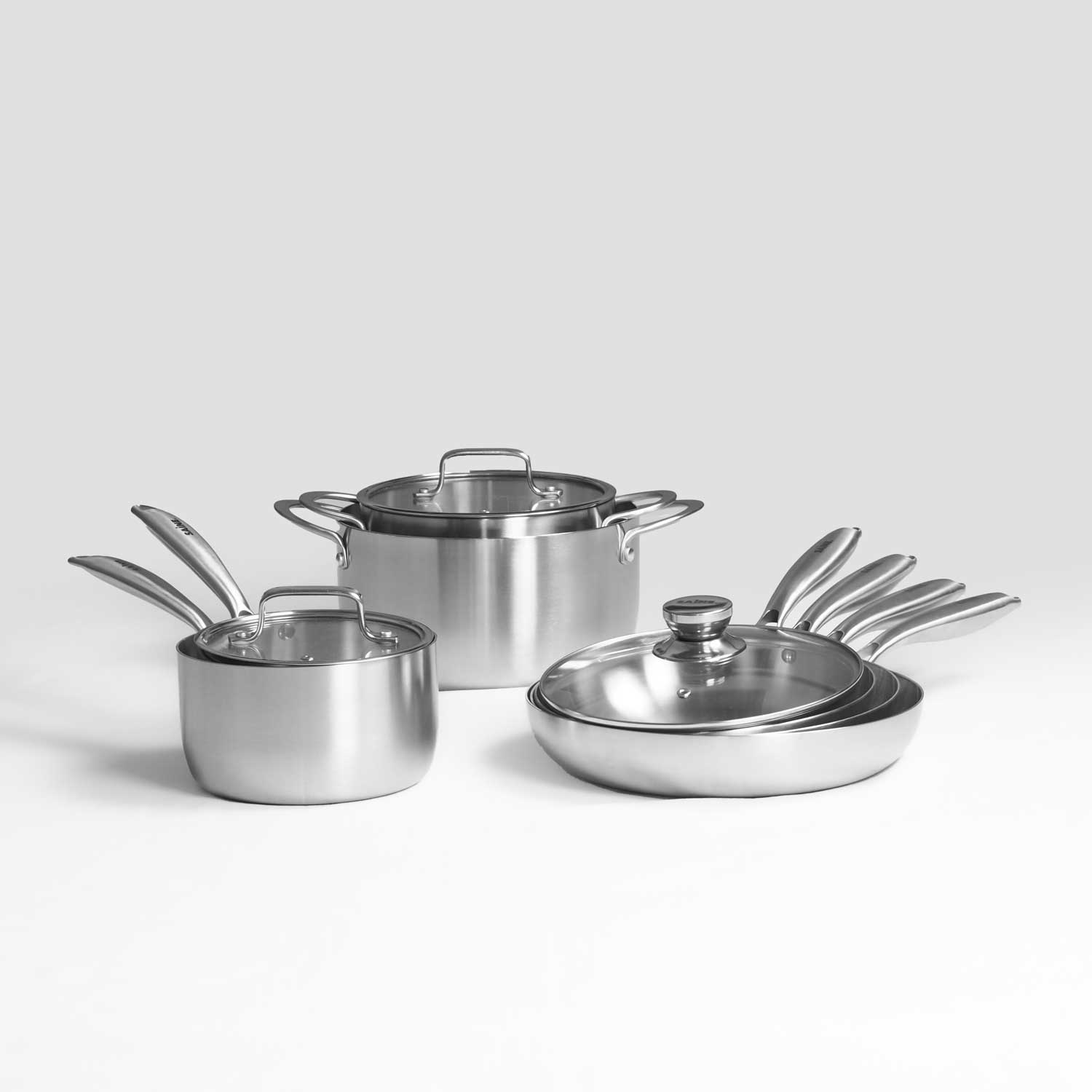
- 🎁 To equip your entire kitchen : Complete cookware set (pots + pans + lids)
Explore our collections:
👉 HEALTHY stainless steel pans - Healthy and sustainable cooking
👉 Complete cookware sets - Easy transition to zero plastic
💬 Frequently asked questions about plastic-free cooking with stainless steel
Is stainless steel really safe?
Yes, absolutely. 18/10 stainless steel is completely inert and does not release any substances into food, even at high temperatures. This has been scientifically proven by independent laboratory tests. In fact, it's the material used in hospitals and the food industry for this very reason.
Doesn't food stick in a stainless steel pan?
No, not if you use the right technique. The secret is preheating: heat your empty pan for 2-3 minutes, test it with a drop of water (it should form a bead that rolls), then add your fat. At the right temperature, stainless steel naturally becomes non-stick thanks to the Leidenfrost effect. Consult our complete guide to master the technique.
How long does a stainless steel pan last?
Several decades, even a lifetime. Stainless steel doesn't degrade over time, doesn't flake, and doesn't lose its properties. Our SAINE pans come with a lifetime guarantee. It's a once-in-a-lifetime investment.
Is it possible to cook without fat in stainless steel?
Yes, it's possible once you master the preheating technique. Contrary to popular belief, you'll use less fat than with a non-stick pan.
Is stainless steel compatible with induction?
Yes, all our SAINE pans have a multi-layer magnetic base compatible with all heat sources: gas, electric, ceramic glass, induction, and even the oven up to 260°C.
How do you clean a stainless steel pan?
It's very simple: add a little water to the still-hot pan to loosen any residue (deglazing), then wash with hot, soapy water and a sponge. For stubborn stains, use baking soda. Stainless steel is also dishwasher safe.
What is the true cost of a transition to stainless steel?
A healthy frying pan costs between €80 and €150 depending on the size. It's a one-time investment that replaces 10 to 15 non-stick pans over a lifetime (cumulative cost: €300-€600). You therefore save money in the long run while protecting your health.
Can I use my metal utensils on stainless steel?
Yes, absolutely. Stainless steel is perfectly resistant to metal utensils. Unlike non-stick coatings that flake off, stainless steel doesn't have a fragile layer to protect.
🌿 Conclusion: Your kitchen deserves better than plastic
The kitchen is the heart of your home. It's where you prepare the meals that nourish your family. It's where your health and the health of your loved ones are at stake.
You deserve better than disposable utensils that release toxic substances into your food.
By choosing a HEALTHY stainless steel pan, you're doing much more than just buying a cooking utensil. You're investing in:
- ✨ Your family's health
- 🌍 The future of the planet
- 👨🍳 The quality of your cuisine
- 💰 Your long-term portfolio
It's a simple, logical, and accessible choice. A choice you'll never regret.
Ready to begin?

Share:
Dangers of PFAS in non-stick pans: What you need to know
Are stainless steel pans really better for your health? (What science says)