


Une poêle en inox qui accroche, qui chauffe mal, qui demande une éternité à nettoyer : c'est la raison numéro un pour laquelle les gens rebroussent chemin vers l'antiadhésif, alors même qu'ils savent que celui-ci contient des PFAS. Le problème n'est presque jamais la poêle. Il est dans trois gestes mal acquis que personne n'explique clairement : préchauffer à vide, attendre le bon signe thermique, et ne pas cuire à feu vif.
Quand j'ai commencé à cuisiner à l'inox il y a quelques années, j'ai fait toutes les erreurs classiques. J'ai brûlé des œufs, soudé un steak au fond de la poêle, et passé quarante minutes à gratter des résidus carbonisés. C'est exactement cette expérience qui m'a amené à créer SAINE, pour accompagner la transition vers l'inox avec un vrai mode d'emploi, pas une fiche technique illisible.
Ce guide couvre tout ce qu'il faut savoir pour utiliser une poêle en inox au quotidien : première utilisation, préchauffage, choix de la matière grasse, gestion de la chaleur, réaction de Maillard, erreurs à éviter, nettoyage. Une fois ces bases en main, la poêle inox devient l'outil le plus polyvalent de votre cuisine, et surtout le plus durable.

Comprendre pourquoi une poêle inox ne fonctionne pas comme un antiadhésif
Avant de parler technique, il faut intégrer une chose : l'inox n'est pas un enduit glissant. C'est un métal. Il ne promet pas que rien ne va jamais attacher, il promet de conduire parfaitement la chaleur, de ne libérer aucune substance toxique, et de durer à vie. Le non-adhésif, en inox, ne vient pas du matériau, il vient de la technique de cuisson.
Dans une poêle antiadhésive, le PTFE (le fameux "Téflon") fait le travail à votre place : il empêche les aliments d'adhérer mécaniquement. Vous pouvez poser un œuf dans une poêle froide, monter en chaleur, et il ne collera pas. En contrepartie, ce revêtement se dégrade avec le temps, il craint les rayures, et il relâche des composés PFAS dès 260 °C.
Dans une poêle en inox, c'est un phénomène physique qui prend le relais : l'effet Leidenfrost. Quand le métal atteint la bonne température, une fine couche de vapeur se forme entre la surface et l'aliment. Cette couche agit comme un coussin thermique et empêche l'adhérence. Ce n'est ni un enduit, ni une magie, c'est de la thermodynamique.
💡 Le point clé : une poêle inox se "pilote", elle ne se pose pas sur le feu. Vous ajustez trois paramètres (préchauffage, matière grasse, température) et tout se passe bien. Sautez un de ces trois et l'aliment colle.
Première utilisation : préparer votre poêle inox neuve
Vous venez de déballer votre poêle. Avant toute chose : lavez-la à l'eau chaude savonneuse avec une éponge non abrasive, rincez soigneusement et séchez-la au chiffon doux. Ce premier lavage retire les résidus d'usinage, les traces de polissage et toute micro-particule de stockage.
🔥 Faut-il culotter une poêle en inox ?
Contrairement à la fonte, l'inox ne se culotte pas au sens traditionnel. Il n'y a pas de patine à développer par couches successives d'huile brûlée. Certains cuisiniers aiment faire un "conditionnement" initial (faire chauffer un peu d'huile à haut point de fumée pour préparer la surface), d'autres jugent cela inutile. Les deux écoles coexistent. J'ai détaillé le pour et le contre dans un article dédié : faut-il culotter une poêle en inox.
🛢️ Première cuisson : commencez simple
Pour la toute première cuisson, partez sur quelque chose de gras et d'indulgent : un oignon émincé dans un filet d'huile, ou des pommes de terre sautées. Évitez les œufs et le poisson pour votre premier passage : ce sont les deux aliments qui pardonnent le moins une technique encore hésitante.
La règle d'or n°1 : préchauffer la poêle inox à vide
C'est l'étape la plus mal comprise, et de loin la plus décisive. Une poêle inox se préchauffe à vide, sans matière grasse, pendant 2 à 3 minutes à feu moyen. Pas feu vif, pas feu doux : feu moyen.
Pourquoi à vide ? Parce que l'huile ajoutée trop tôt chauffe en même temps que le métal, passe son point de fumée avant que la poêle n'atteigne sa température cible, et se dégrade. Résultat : une couche d'huile oxydée qui colle au fond, et des aliments qui accrochent par-dessus.
Pourquoi feu moyen et pas feu vif ? Parce que l'inox, surtout en tri-ply, conduit très efficacement la chaleur. Un feu vif fait monter la température au-delà du seuil utile, crée des points chauds sur le fond, et brûle les aliments avant qu'ils ne saisissent.

💧 Comment savoir quand la poêle est prête : le test de la goutte d'eau
Il existe un indicateur visuel simple et infaillible : le test de Leidenfrost. Au bout de 2 à 3 minutes de chauffe, versez quelques gouttes d'eau dans la poêle. Trois scénarios possibles :
- ❌ L'eau s'évapore en grésillant lentement : la poêle n'est pas assez chaude. Continuez à chauffer.
- ✅ L'eau forme une ou plusieurs perles qui glissent sur la surface : c'est le signe que l'effet Leidenfrost est atteint. Vous pouvez ajouter la matière grasse.
- ⚠️ L'eau éclate en mille micro-gouttes qui fument : la poêle est trop chaude, retirez-la du feu 30 secondes pour la laisser redescendre.
Pour une démonstration pas à pas avec les températures associées, consultez le guide dédié : comment faire le test de la goutte d'eau sur une poêle inox.
⚠️ Erreur classique : verser l'huile dans la poêle froide puis monter en température. C'est ce qui fait accrocher 90 % des œufs au plat. La séquence correcte est : poêle à vide → chauffe → test de la goutte → huile → aliment.
La règle d'or n°2 : choisir la bonne matière grasse (et l'ajouter au bon moment)
Une fois la poêle chaude, vous ajoutez la matière grasse. L'ordre est important : poêle chaude → matière grasse → 10 à 15 secondes d'attente → aliment. Ces 10 secondes permettent à l'huile de se fluidifier, de s'étaler et d'atteindre elle-même la bonne température.
Le critère déterminant pour choisir la matière grasse, c'est son point de fumée, la température à partir de laquelle elle se dégrade et libère des composés indésirables (acroléine, aldéhydes). Voici un comparatif des matières grasses les plus courantes pour une cuisson à la poêle inox.
La règle pratique : pour une saisie ou une réaction de Maillard, préférez une huile à point de fumée supérieur à 220 °C. Pour des légumes doucement fondus ou une omelette, une huile à point de fumée plus bas (comme l'olive vierge) suffit largement.
Pour aller plus loin sur ce sujet technique, je détaille tous les cas de figure dans quelle huile utiliser dans une poêle en inox.
La règle d'or n°3 : cuire à feu moyen, jamais à feu vif
C'est la règle la moins intuitive, surtout quand on vient de l'antiadhésif. L'inox conduit mieux la chaleur que la plupart des autres matériaux de cuisson, en particulier les poêles à fond capsulé ou tri-ply qui intègrent une couche d'aluminium pour la diffusion. Un feu vif n'est presque jamais nécessaire, et il est même souvent contre-productif.
Le feu vif surchauffe le métal au-delà du seuil utile, carbonise les sucs avant qu'ils ne développent leurs arômes, et peut faire passer l'huile au-dessus de son point de fumée. Résultat : des aliments noirs dessus, crus dedans, et des résidus incrustés au fond.
Voici les réglages que j'applique au quotidien, sur une plaque à induction graduée de 1 à 9.
Notez que le feu vif (8-9 sur induction) n'apparaît nulle part dans ce tableau. Il est réservé à l'ébullition rapide de grandes quantités d'eau, pas à la cuisson à la poêle. Pour ceux qui cuisinent à l'induction, j'ai détaillé les réglages spécifiques dans le guide poêle inox et induction.
Réussir la réaction de Maillard à la poêle inox
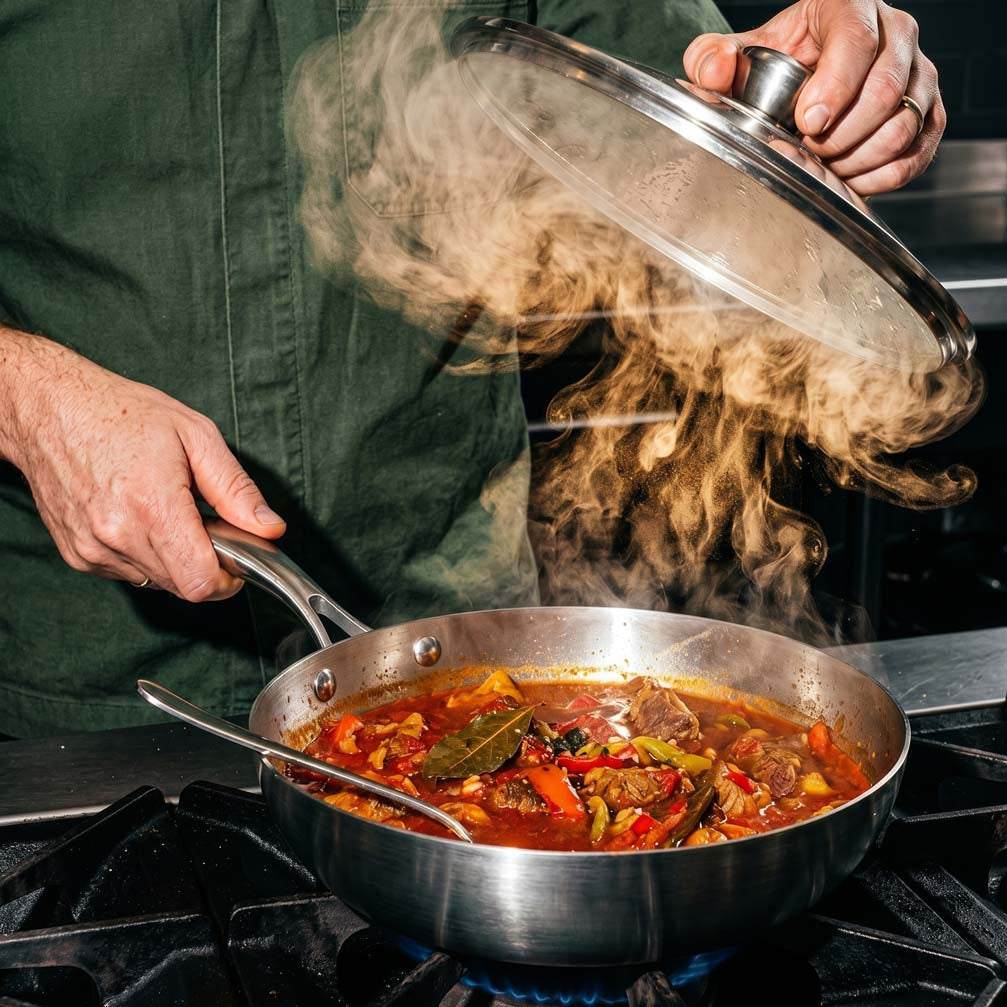
Si vous retenez une seule chose de cet article : la viande se décolle toute seule quand elle est prête. Cette phrase résume à elle seule la mécanique de la réaction de Maillard dans une poêle inox, et elle évite la plupart des frustrations.
La réaction de Maillard, c'est ce brunissement caramélisé qui donne le goût et les arômes typiques d'une saisie réussie : un steak, un magret de canard, un pavé de saumon, des sucs au fond de la poêle qui deviennent la base d'une sauce. Elle se déclenche entre 140 et 165 °C, quand les acides aminés et les sucres de la surface de l'aliment réagissent à haute température.
Le comportement à adopter est simple : quand vous posez la viande dans la poêle chaude, ne la bougez pas. Au début, elle va adhérer au fond. C'est normal. Au fur et à mesure que la surface caramélise, une croûte se forme, et cette croûte se détache naturellement du métal. Si vous essayez de soulever la viande et qu'elle résiste, c'est qu'elle n'est pas prête. Laissez-la encore 30 secondes à 1 minute et elle se décollera d'elle-même.
✅ La checklist d'une saisie réussie :
- 🥩 Viande à température ambiante (sortie du frigo 20 min avant)
- 🧻 Surface séchée au papier absorbant (l'eau empêche le Maillard)
- 🔥 Poêle très chaude, test de la goutte validé
- 🛢️ Huile à haut point de fumée (avocat, ghee, tournesol oléique)
- ⏱️ Patience : 2 à 3 minutes par face sans toucher

Pour la théorie complète sur ce phénomène, je vous recommande l'article dédié à la réaction de Maillard, et pour les techniques spécifiques aux différentes viandes : techniques pour une saisie parfaite.
Que cuisiner dans une poêle inox et comment adapter la technique
Une poêle inox bien utilisée fait tout, ou presque. Voici les grandes familles de cuisson et les réglages associés, pour que vous sachiez quoi sortir de la poêle le jour où vous l'achetez.
🥩 Viandes rouges et blanches
Saisie à feu moyen-vif pour les viandes rouges (5 à 7 sur induction), feu moyen pour la volaille et le porc. La poêle inox excelle sur les cuissons à la française qui demandent des sucs pour déglacer. Le fond de poêle récupère tous les arômes de caramélisation, ce qu'une poêle antiadhésive ne permet pas.
🐟 Poissons
Peau croustillante, chair nacrée : l'inox est redoutable pour le saumon et les poissons à peau (bar, dorade). Préchauffage classique, huile haut point de fumée, peau vers le bas, patience. Comme pour la viande, le poisson se décolle quand il est prêt.
🍳 Œufs
C'est l'épreuve du feu pour tout cuisinier qui débute à l'inox. La clé : feu moyen (pas vif), beurre ou huile bien chaude, et casser l'œuf doucement. C'est un sujet à part entière, traité dans comment cuire des œufs au plat à l'inox sans qu'ils n'attachent.
🥕 Légumes
Du sauté rapide au légume confit, en passant par la caramélisation des oignons, l'inox est parfait. Pour les légumes à forte teneur en eau (champignons, courgettes), ne surchargez pas la poêle, sinon ils rendent leur eau et bouillent au lieu de sauter.
🍲 Sauces et déglaçages
C'est là que l'inox prend sa revanche définitive sur l'antiadhésif. Les sucs collés au fond après une saisie (ce qu'on appelle en cuisine le "fond de poêle") sont la base de toutes les grandes sauces classiques. Un peu de vin, de bouillon ou de crème, une spatule en bois pour décrocher les sucs, et vous avez une sauce restaurant en 3 minutes.
Pour un panorama complet des recettes qui tirent le meilleur parti de l'inox, consultez le guide que cuisiner dans une poêle en inox : 10 idées de recettes, et pour un cas d'école débattu, la cuisson sans matière grasse à l'inox.
Les erreurs à éviter lors de vos cuissons à l'inox
Ces erreurs concentrent 90 % des déceptions quand on passe à l'inox. Les identifier permet de les corriger en une seule cuisson.
❌ Verser l'huile dans la poêle froide
On en a parlé, mais ça mérite d'être répété : l'huile chauffe trop lentement, se dégrade, et colle. Toujours préchauffer à vide, puis ajouter l'huile.
❌ Poser un aliment sortant du frigo dans une poêle chaude
Le choc thermique brutal refroidit localement le métal, fait sortir l'eau de l'aliment, et provoque l'adhérence. Sortez la viande, le poisson ou le fromage 15 à 20 minutes avant la cuisson.
❌ Remuer en permanence
Cuisiner à l'inox demande de la patience. Poser, attendre, retourner. Une viande ou un poisson qui est remué toutes les 10 secondes ne caramélisera jamais correctement et aura tendance à accrocher.
❌ Cuire à feu vif "pour aller plus vite"
L'inox conduit si bien la chaleur que le feu vif est presque toujours excessif. Vous brûlez la surface avant que la cuisson ne pénètre. Feu moyen, patience, résultat.
❌ Surcharger la poêle
Trop d'aliments font chuter la température et rendent leur eau. Cuire en 2 ou 3 fournées vaut mieux qu'une grosse fournée ratée.
Si malgré tout vos aliments continuent à accrocher systématiquement, l'article frère du silo détaille toutes les solutions : comment empêcher les aliments d'accrocher à l'inox.
Nettoyer votre poêle inox après cuisson sans l'abîmer
Le bon réflexe : nettoyer la poêle pendant qu'elle est encore tiède, pas brûlante, et surtout pas glacée. Un choc thermique entre une poêle chaude et de l'eau froide peut, avec le temps, provoquer un fond gondolé.
Pour une cuisson classique, eau tiède, liquide vaisselle et éponge non abrasive suffisent dans 95 % des cas. Pour les résidus tenaces, deux options efficaces :
- 💧 La méthode à l'eau chaude : versez 1 cm d'eau dans la poêle encore tiède, remettez sur feu moyen 2 minutes. Les sucs se décrochent tout seuls.
- 🧂 La méthode bicarbonate : saupoudrez de bicarbonate, ajoutez un peu d'eau, laissez agir 10 minutes puis frottez avec une éponge douce.
⚠️ À proscrire absolument : les éponges métalliques agressives, les pailles de fer, la laine d'acier. Elles rayent la surface et créent des zones d'adhérence permanente. Pour les taches rebelles (arc-en-ciel, traces calcaires), un chiffon imbibé de vinaigre blanc fait des miracles.
Le sujet du nettoyage en profondeur et de la récupération d'une poêle brûlée mérite son propre guide complet : le guide complet de l'entretien d'une poêle en inox.
Quelle poêle inox choisir pour bien débuter ?
Tout ce qui précède suppose que vous ayez une poêle inox de qualité. Une poêle bas de gamme à fond fin, sans construction multi-couches, annule la moitié des bénéfices : elle fait des points chauds, déforme au premier feu vif, et vous fait penser à tort que la technique est en cause.
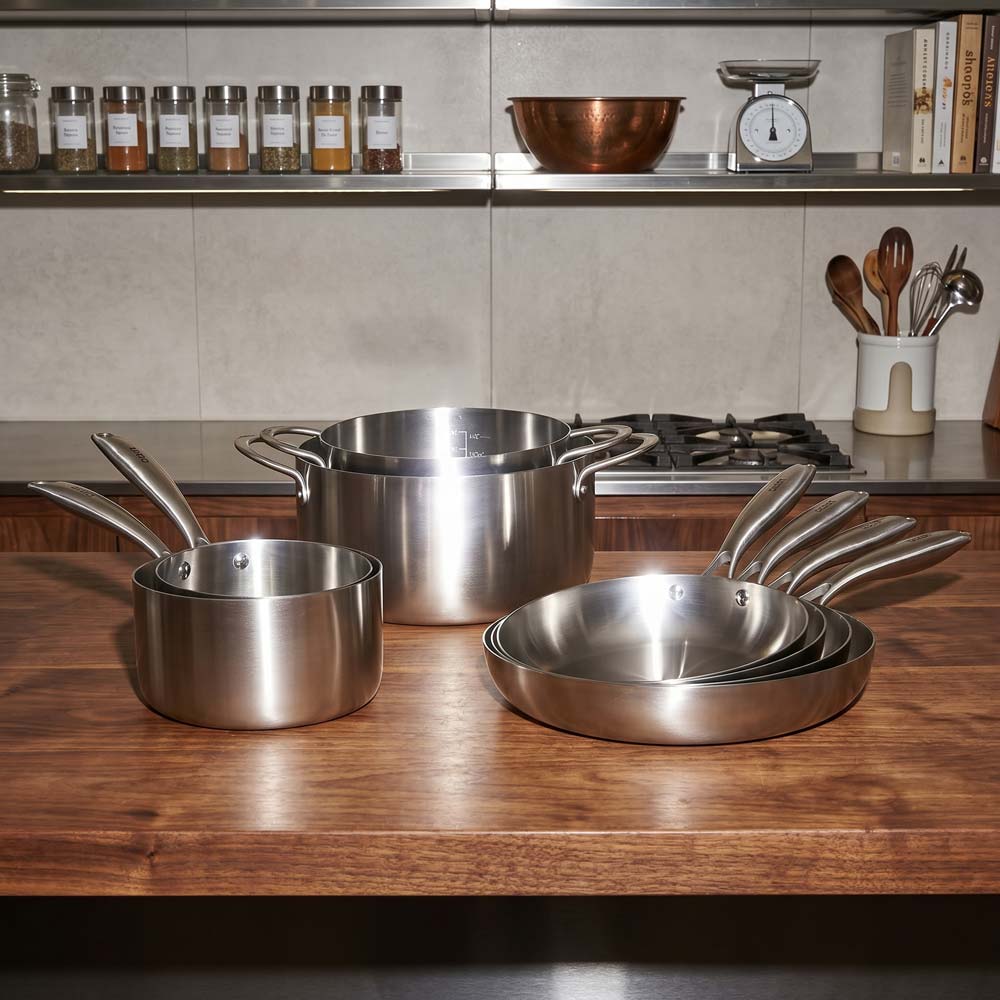
Les critères qui comptent : inox 18/10 sur la face de contact alimentaire, fond tri-ply avec couche d'aluminium pour la diffusion, manche riveté pour la robustesse, et compatibilité induction. La poêle poêle inox SAINE 28 cm coche ces quatre critères et représente le diamètre le plus polyvalent (2 à 4 personnes).
Si vous êtes encore en phase de comparaison entre modèles et marques, j'ai mis à jour mon comparatif des meilleures poêles inox 2026 avec les modèles que je recommande selon les usages et les budgets.
Et si la question du matériau elle-même vous taraude encore (inox, fonte, céramique, antiadhésif), la réponse santé est dans le comparatif complet de la poêle la plus saine pour la santé.
FAQ : la cuisson à la poêle inox, les questions fréquentes
Pourquoi ma poêle inox noircit-elle au fond quand je cuisine ?
Ce "noircissement" est le plus souvent une couche d'huile oxydée qui s'est dégradée au-dessus de son point de fumée, ou des sucs alimentaires carbonisés par un feu trop vif. Ce n'est pas toxique et c'est réversible. Solution : feu moyen, huile adaptée, et un passage au bicarbonate ou au vinaigre blanc pour retirer la couche.
Combien de temps faut-il préchauffer une poêle inox ?
Entre 2 et 3 minutes à feu moyen pour une poêle de 28 cm, un peu moins pour une 24 cm. L'indicateur fiable n'est pas le chrono mais le test de la goutte d'eau : dès qu'une perle d'eau glisse sur la surface sans s'évaporer, la poêle est prête.
Peut-on cuisiner à feu vif avec une poêle en inox ?
Occasionnellement, pour une saisie très courte de viande rouge (steak mince, 1 à 2 minutes par face), oui. En usage courant, non. L'inox conduit suffisamment bien la chaleur pour que le feu moyen suffise. Le feu vif permanent use la poêle, brûle les aliments et réduit la maîtrise de la cuisson.
Faut-il préchauffer la poêle inox à vide ou avec l'huile ?
À vide, toujours. Ajoutez l'huile une fois que le test de la goutte d'eau est concluant. Préchauffer avec l'huile déjà dedans fait dégrader la matière grasse avant que la poêle ne soit utilement chaude.
Quelle est la différence entre une poêle inox et une poêle tri-ply ?
Une poêle "inox" simple a un seul métal (inox plein ou avec un fond capsulé en aluminium). Une poêle "tri-ply" a trois couches sur toute la surface : inox sur la face cuisson, aluminium au centre pour la diffusion, inox à l'extérieur. Le tri-ply chauffe plus uniformément, sans points chauds, et c'est la construction que je recommande pour un usage quotidien.
Peut-on utiliser des ustensiles en métal sur une poêle inox ?
Oui, sans restriction. L'inox n'a pas de revêtement à abîmer. Spatules en métal, fouets, pinces : tout est permis. C'est un des gros avantages par rapport à l'antiadhésif qui impose des ustensiles en bois ou en silicone.
Ma poêle inox a des taches arc-en-ciel, est-ce grave ?
Non. Ces reflets irisés sont dus à une oxydation de surface provoquée par la chaleur et certains minéraux de l'eau. Ils sont purement esthétiques, totalement inoffensifs, et partent au vinaigre blanc ou au citron dilué.
Une poêle inox convient-elle à tous les types de feux ?
Si elle est compatible induction (socle ferromagnétique), elle fonctionne aussi sur gaz, plaques vitrocéramiques, plaques électriques et souvent au four. C'est le matériau de cuisson le plus universel. Vérifiez simplement le pictogramme induction sous la poêle avant l'achat.
Bien utiliser sa poêle inox : les 3 réflexes qui changent vos cuissons
Si vous ne deviez retenir que trois choses de ce guide, les voici. Ce sont les mêmes trois que j'applique à chaque cuisson dans ma cuisine, et ce sont celles qui font la différence entre une poêle qu'on adore et une poêle qu'on évite.
✅ Les 3 réflexes qui changent tout :
- 🔥 Préchauffer à vide, 2 à 3 minutes, feu moyen, test de la goutte avant l'huile
- 🛢️ Huile à haut point de fumée (avocat, ghee, tournesol oléique) pour toutes les saisies
- ⏱️ Feu moyen, patience, l'aliment se décolle seul quand il est prêt
La cuisson à l'inox n'est ni complexe ni intimidante. Elle demande juste de changer deux ou trois automatismes hérités de l'antiadhésif. En contrepartie, vous gagnez une poêle qui dure à vie, qui n'intègre aucun PFAS, qui permet de faire des sauces avec des sucs de poêle, et qui va au four sans aucune limite de température.
Si vous cherchez à remplacer votre poêle antiadhésive par un modèle inox fiable, notre comparatif 2026 des meilleures poêles en inox présente les modèles que je recommande selon les usages.
📚 Sources et références citées :
- ANSES, Points de fumée et stabilité thermique des huiles alimentaires (fiches matières grasses)
- INRAE, Réaction de Maillard et formation des arômes en cuisson
- Effet Leidenfrost : Journal of Heat Transfer, études sur le transfert thermique air-eau sur surfaces métalliques
- UFC-Que Choisir, tests comparatifs de poêles et conseils d'utilisation (éditions 2023 à 2025)


Partager:
Cuisson de la viande dans une poêle en inox : la technique pour une saisie parfaite
Cuisson sans matière grasse à la poêle inox : mythe ou réalité ?